Evaluating the Pirate Numbers Topper 3D SVG Collection for Professional Crafters
In the current landscape of digital crafting, the distinction between a standard graphic file and a production-ready asset often comes down to dimensionality and compatibility. The Pirate Numbers Topper collection represents a specific niche within this market: a set of three-dimensional scalable vector graphics designed primarily for celebratory decor. For professionals and serious hobbyists who rely on cutting machines like Silhouette Cameo or Cricut Maker, understanding the technical nuances of such a collection is essential before integrating it into a commercial workflow or a high-stakes personal project.
This analysis examines the Pirate Numbers Topper not merely as a decorative item, but as a functional tool. We will explore its file architecture, material adaptability, and practical application across various substrates, offering a realistic perspective on where this asset fits within a broader creative strategy.
Technical Architecture and File Compatibility
The core value proposition of the Pirate Numbers Topper lies in its format. Delivered as an SVG (Scalable Vector Graphic) collection, these files are inherently resolution-independent. Unlike raster images (JPEGs or PNGs) which pixelate when enlarged, vector paths allow the pirate-themed numerals to be scaled from a small sticker to a large banner without any loss of edge definition. This is critical for professionals who need to adjust dimensions on the fly based on client requests or material constraints.
Compatibility is straightforward for users within the major ecosystems. The files are engineered to import seamlessly into Silhouette Studio and Cricut Design Space. Upon import, the layers are typically pre-separated or grouped logically, reducing the time spent on manual cleanup. However, a crucial step for any operator is verifying machine settings. While the software compatibility is broad, the physical hardware must be capable of handling the specific cut complexity associated with 3D layering. Users should ensure their blade depth and pressure settings are calibrated for the chosen material, as intricate number shapes can sometimes lead to weeding challenges if the cut is not precise.
The Mechanics of 3D Layering
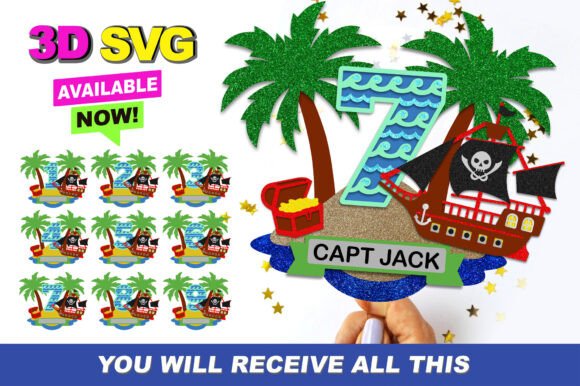
What differentiates this collection from flat clipart is the "3D" designation. In the context of paper crafting and vinyl application, this implies a multi-layer construction. The Pirate Numbers Topper is designed with offset layers that, when stacked, create a shadow effect or a literal rise in elevation. This technique adds visual weight and professionalism to the final product.
From a production standpoint, this requires a shift in workflow. Instead of a single cut-and-apply process, the creator must manage multiple material layers. For example, creating a cake topper might involve cutting the primary numeral in a bold cardstock, while the shadow layer is cut in a contrasting color or a slightly larger size to create depth. The precision of the vector paths in this collection facilitates this stacking. If the offsets were inconsistent, the layers would misalign, ruining the 3D illusion. In testing, the alignment points in these files generally hold up well, provided the user maintains consistent material thickness across layers.
Material Versatility and Application Scenarios
The utility of the Pirate Numbers Topper extends well beyond the traditional paper cake topper. Its vector nature makes it highly adaptable to various mediums, each presenting unique opportunities and challenges for the creator.
- Cardstock and Paper: This is the most common application. The files are perfectly proportioned for structural integrity when cut from 65lb to 80lb cardstock. They serve excellently as birthday bash decor, cupcake wrappers, or standalone table numbers.
- Heat Transfer Vinyl (HTV): For apparel, these graphics translate effectively to swanky shirt prints. The clean lines ensure that small details, such as the curves of the numbers or pirate-specific embellishments, do not get lost during the weeding process. However, intricate 3D layering with HTV can be labor-intensive; many professionals opt to use the primary layer only for shirts to maintain comfort and durability.
- Adhesive Vinyl and Stickers: When applied to smooth surfaces like water bottles, laptops, or party favors, the vibrant potential of these files shines. Using glossy or holographic vinyl can enhance the "electrifying" aesthetic mentioned in the product description, making them ideal for modern, high-energy events.
- Acrylic and Wood: For more permanent merchandise, these SVGs can drive laser cutters or CNC machines. The scalability allows for the creation of large wooden signs or acrylic cake stands, though users must verify that the file nodes are optimized for their specific laser software to prevent burning at sharp corners.
Workflow Efficiency for Small Business Owners
For entrepreneurs and freelancers, time is a direct correlate to profitability. The Pirate Numbers Topper offers significant value by reducing design time. Instead of sketching custom numerals and manually creating offset layers—a process that can take hours—users gain immediate access to a ready-to-cut library. This allows small business owners to focus on assembly, marketing, and customer service rather than foundational design work.
Furthermore, the consistency of the font style across all numbers ensures brand coherence. Whether a client orders a "1st Birthday" or a "50th Birthday," the visual language remains uniform. This reliability is essential for building a portfolio of work that looks professional and curated. The collection supports the creation of a lifetime of splendid memories and merchandise by providing a dependable base upon which creators can build their unique variations.
Realistic Limitations and Considerations
While the Pirate Numbers Topper is a robust tool, it is not without limitations that a prudent buyer should consider. First, the "3D" effect is entirely dependent on the user's execution. The file provides the paths, but the physical depth relies on the thickness of the adhesive or foam tape used between layers. Inexperienced users may struggle to achieve a clean look if they apply too much adhesive, causing the layers to bulge unevenly.
Additionally, while the files are compatible with major software, users operating on older versions of Silhouette Studio (basic edition) may face restrictions if the file utilizes advanced features like print-and-cut registration marks that require upgraded licenses. It is always advisable to check software version requirements before purchase.
There is also the matter of theme specificity. As a pirate-themed set, its utility is naturally bounded by niche events. It is an exceptional resource for maritime-themed parties, adventure birthdays, or specific branding needs, but it lacks the generic versatility of a standard alphabet set. Professionals should evaluate their client base to ensure there is a demand for this specific aesthetic before investing heavily in bulk production using these files.
Long-Term Value and Strategic Integration
The long-term value of the Pirate Numbers Topper lies in its reusability. Unlike a physical mold that wears out, a digital SVG can be used indefinitely. Once purchased and downloaded, it becomes a permanent asset in the creator's library. This makes it a cost-effective solution for educators teaching design principles, bloggers creating content visuals, or marketers designing campaign assets.
To maximize return on investment, creators should consider bundling these graphics with complementary elements. For instance, pairing the numbers with matching pirate ship or treasure chest SVGs (if available in the same series) can create comprehensive party kits. This approach increases the perceived value for the end consumer and allows the creator to command higher price points for custom orders.
In conclusion, the Pirate Numbers Topper 3D SVG collection is a specialized, high-quality asset that bridges the gap between amateur crafting and professional production. Its strength lies in its technical precision, scalability, and ease of integration into standard workflows. While it requires a degree of skill to execute the 3D layering effectively, the resulting products offer a level of sophistication that flat graphics cannot match. For those whose audience aligns with the adventurous, nautical theme, this collection provides a reliable foundation for creating memorable, high-impact visual experiences.